
Measure Sound Better
Auto Frequency Selection: Best Frequency, Auto-Found

In noisy environments, selecting the correct test frequency is critical. If the right frequency range isn’t chosen, many key leakage points and partial discharge (PD) sources—often with serious safety risks—may go undetected, posing a threat to safe operations.
To address this, CRYSOUND has developed an Auto Frequency Selection feature for its handheld acoustic imaging camera. Simply aim the center of the view at a suspected leakage or PD location, and the system will automatically set the frequency range to the most suitable span.
Why is it so hard to choose the right frequency range in different environments?
The noisier the environment, the easier it is to pick the wrong frequency range—especially in scenarios like gas leak detection and partial discharge (PD) inspection. Common challenges include:
Gas leak detection: Gas leak noise is often broadband, while the site is also filled with broadband background noise such as wind, turbulent flow from valves/pipelines, and compressor rumble. The spectrum can look “full of energy,” making it easy to lock onto the loudest background band and miss the frequency range where the leak’s real acoustic features stand out.
Partial discharge (PD): PD signals are typically short and weak, and their frequency distribution can be affected by electromagnetic interference and reflection paths. As a result, the spectrum may show many sharp peaks, but it’s not obvious which ones are truly relevant to PD—choosing the wrong band can lead to inaccurate localization or missed detections.
Principle and Operating Steps of Auto Frequency Selection
How Auto Frequency Selection works: The acoustic imaging camera captures the characteristic audio signal from the central area of the display. Using an algorithm, it filters out interfering noise from other directions and automatically adjusts to the optimal test frequency range, with a response time of less than 0.5 seconds.

Operating Steps:
Step 1: Place the target in the center of the video view.
Step 2: The acoustic imaging camera analyzes the spatial distribution characteristics of the sound from the central target and calculates the dominant frequency peaks as well as the frequency band with the best signal-to-noise ratio (SNR).
Step 3: Based on the algorithm results, the camera automatically sets the recommended lower and upper frequency limits, so the frequency range on the right side automatically jumps to the optimal band for gas leak and partial discharge (PD) testing.
In practice, you only need to keep the suspected leak/PD point in the center of the view. The system will automatically identify it and set the frequency band to the range with the best test performance. If you find a suspicious location, aim the center of the acoustic image at the potential leak/PD area, change the viewing angle to confirm whether the leak/PD source remains visible, and then capture a photo for documentation.
Comparison of Manual vs. Auto Frequency Selection Results
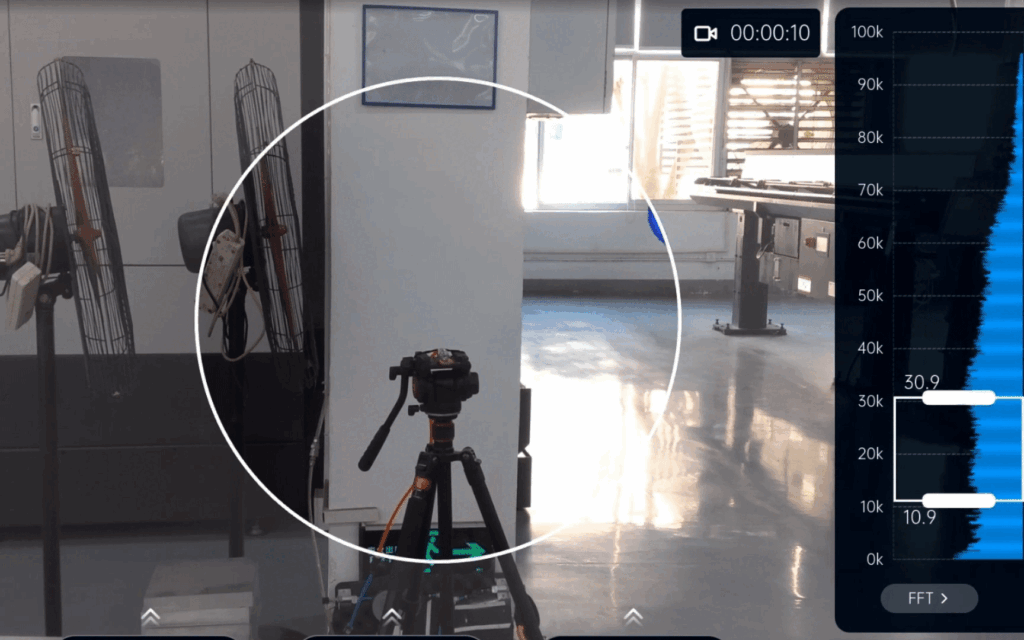
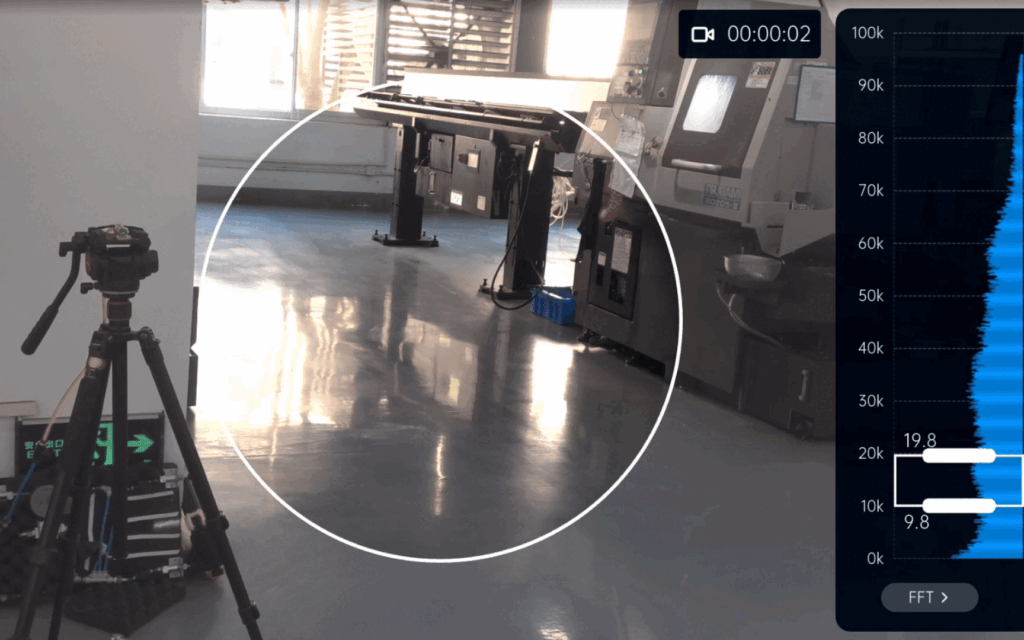
Advantages of Auto Frequency Selection: Faster, More Stable, and Less Likely to “Target the Wrong Source”
- Select the right band, reduce missed detections, and improve inspection efficiency
Auto Frequency Selection locks onto the right frequency range in one step, reducing trial-and-error, missed detections, and rework—so on-site inspections become faster, more accurate, and overall more efficient.
- More reliable in noisy environments
Instead of searching for frequencies across the entire scene, Auto Frequency Selection extracts spectral features based on the centered target, which helps reduce the impact of background noise.
- More stable imaging
The recommended frequency band is derived from the target’s actual spectral characteristics, making it closer to the true sound source—resulting in more concentrated hotspots and more stable localization on the acoustic image.
Typical Applications: Where Auto Frequency Selection Works Best
- Noisy production lines / equipment inspection
Bearing faults, friction noise, looseness and resonance
Tasks with high background noise where fast localization is required
- Gas leak detection
Compressed air leaks, vacuum leaks, and other gas leaks
- Ultrasonic applications such as partial discharge (PD)
Abnormalities that require observation in higher frequency bands (e.g., discharge events and other ultrasonic features)
The value of Auto Frequency Selection is that it makes the most experience-dependent step in acoustic imaging smarter. Once the acoustic imaging camera is aimed at the target, it can automatically select the optimal test frequency band based on the characteristics of leakage noise or partial discharge (PD), enabling fast and accurate identification of leak/PD points and helping users make correct decisions more efficiently.
If you would like to learn more about the Auto Frequency Selection feature in CRYSOUND acoustic imaging products, or discuss a more suitable inspection solution based on your on-site process and acceptance requirements, please contact us via the form below. Our sales or technical support engineers will get in touch with you.